Skip to page content

Meet Surveyor 1

Every part, up close

Turn it, pick a part to see what it did, pull the parts apart, or download it to print your own.

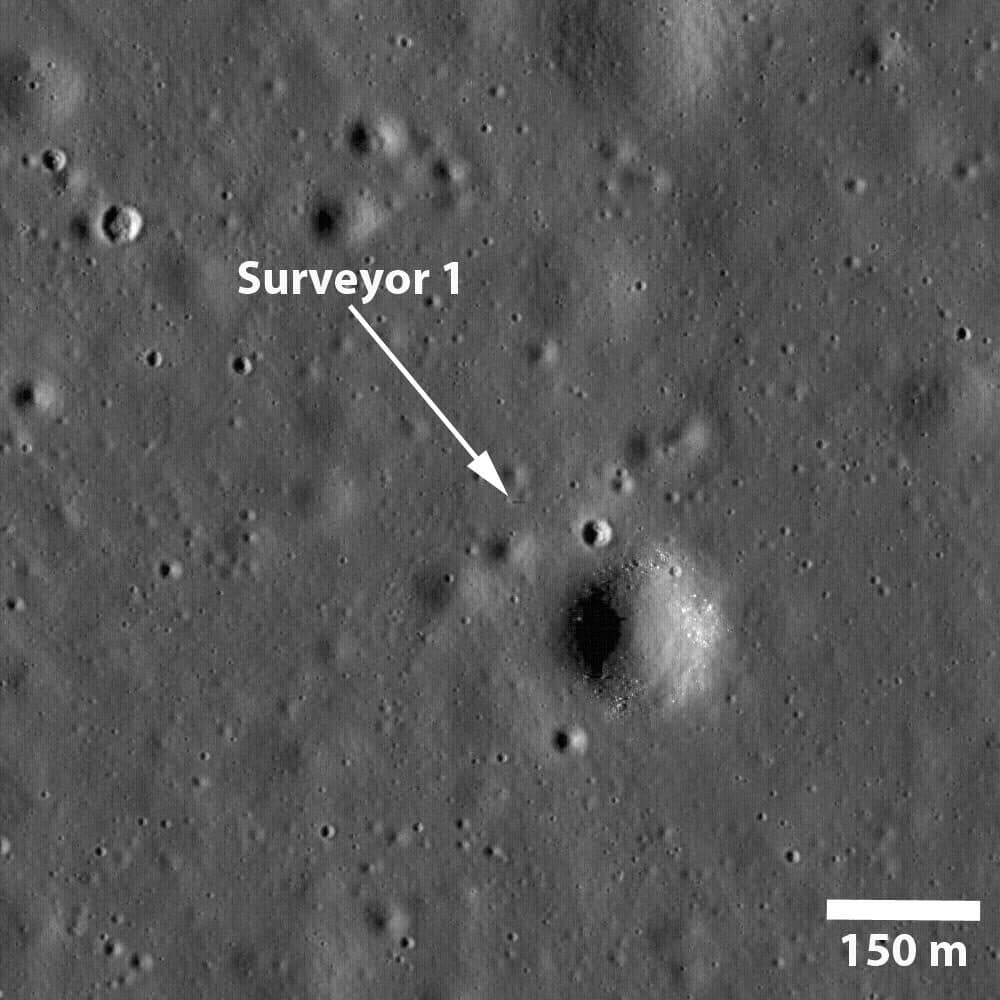
NASA Surveyor 1 spacecraft sitting silently on Oceanus Procellarum, the first US spacecraft to land on another planet on June 2, 1966 in this image taken by NASA Lunar Reconnaissance Orbiter.
Drag to turn · pinch or scroll to zoom

Parts

Download

NASA has not published a 3D model of Surveyor 1, so this is a simplified model made for this site from NASA photos and descriptions. Shapes and parts follow the real machine; sizes are approximate.

The film · 6 scenes

The machine that proved the Moon was solid. It touched down in the Ocean of Storms, survived a 14-day lunar night, and woke up to send pictures again.

From why it was built to its last signal, told in real NASA photographs. Scroll through it, or press play.

Watch the film

Surviving the night

Surveyor 1 had only a solar panel and batteries. No one knew if it would live through the 14-day lunar night. It did.

  • First lunar day, 2–14 June 196610,622 pictures
  • Second lunar day, from 6 July 1966618 pictures

    after waking up from the night

Born on Earth

Launch

A rocket lifting off at night (AI-generated placeholder)
AI-generated placeholder

30 May 1966
Atlas-Centaur · Launch Complex 36A

Built by Hughes Aircraft.

Arrival on Moon

Landing

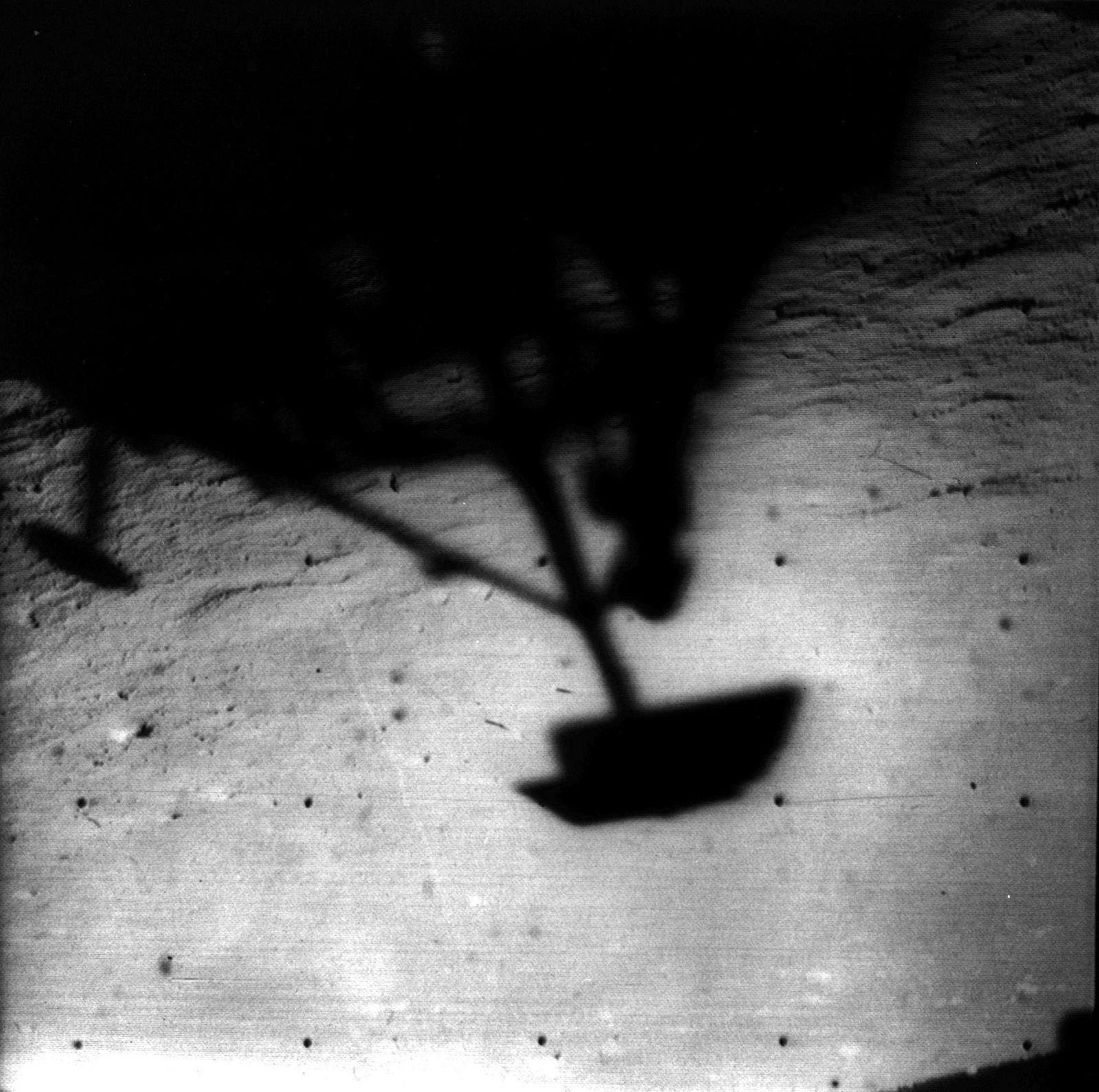
Image of Surveyor 1 shadow against the lunar surface in the late lunar afternoon, with the horizon at the upper right.
Surveyor 1 Shadow · NASA/JPL

2 June 1966
Oceanus Procellarum · Retro-rocket soft landing

Life’s work

They went where we couldn’t.

  1. Image of Surveyor 1 shadow against the lunar surface in the late lunar afternoon, with the horizon at the upper right.No. 01

    Seven landers

    1961

    NASA picked Hughes Aircraft to build seven Surveyor landers under JPL's technical direction.

  2. Image of Surveyor 1 shadow against the lunar surface in the late lunar afternoon, with the horizon at the upper right.No. 02

    First try

    2 June 1966

    It touched down in the Ocean of Storms 63.6 hours after launch, about 14 km from its target.

  3. Image of Surveyor 1 shadow against the lunar surface in the late lunar afternoon, with the horizon at the upper right.No. 03

    11,240 pictures

    1966

    By 6 July 1966 it had sent back 11,240 pictures over two sessions.

  4. NASA Surveyor 1 spacecraft sitting silently on Oceanus Procellarum, the first US spacecraft to land on another planet on June 2, 1966 in this image taken by NASA Lunar Reconnaissance Orbiter.No. 04

    Seen again

    2009

    NASA's Lunar Reconnaissance Orbiter photographed Surveyor 1, still sitting on Oceanus Procellarum.

Fell silent after the lunar nights

Last signal

07.01.1967

Surveyor 1 survived the long lunar nights and answered Earth on and off for seven months before its final contact in January 1967.

Background: Surveyor 1 -- America First Soft Lunar Landing · NASA/GSFC/Arizona State University

The full story

Surveyor 1, from start to finish

Surveyor 1 was the first American spacecraft to soft-land on the Moon. It touched down in the Ocean of Storms on 2 June 1966, on NASA's first attempt, and showed that a spacecraft could land safely on the lunar surface and send back useful science, three years before Apollo 11.

Why it was built

Before people could land on the Moon, scientists needed to know what the surface was like up close. The Surveyor landers, managed by NASA's Jet Propulsion Laboratory, were the robotic precursors of Apollo: they gave a ground-level view of possible landing sites, while the Lunar Orbiters mapped them from above.

In January 1961 NASA selected Hughes Aircraft Company to build seven soft-landing vehicles, under JPL's technical direction, to "land gently on the Moon, perform chemical analyses of the lunar surface and subsurface and relay back to Earth television pictures of lunar features."

The spacecraft

Surveyor stood about 3 m tall on a thin-walled aluminium triangle weighing 27 kg, with a leg at each corner. A large solid-propellant retro-rocket in the centre made up more than 60% of its mass. A Doppler velocity-sensing system fed the spacecraft computer for a controlled descent, and each landing pad carried aircraft-type shock absorbers and strain gauges to record the landing, data that mattered for Apollo.

Its television camera could see detail down to one millimetre at a distance of four metres, and a filter wheel with red, green and blue filters let engineers build colour images.

First try

Surveyor 1 launched on an Atlas-Centaur from Cape Kennedy on 30 May 1966. After a 63.6-hour coast it landed in the Ocean of Storms at 06:17:36 UT on 2 June, inside the crater Flamsteed P, bouncing once before settling, about 9 miles (14 km) from its target. Having used its descent fuel and dropped its retro-rocket, it weighed 294.3 kg.

Thirty-six minutes after landing it sent its first picture, showing part of the spacecraft, one landing pad and the dark lunar soil.

Surviving the night

It returned 10,622 images, including the first colour photo, before the first lunar nightfall on 14 June. With only a solar panel and batteries, no one knew if it would survive the 14-Earth-day night, and contact attempts on 28 June failed. On 6 July it answered, and sent another 618 images in its second lunar day: 11,240 in all.

After its second sunset on 13 July the battery voltage dropped sharply. Controllers kept intermittent contact until 7 January 1967.

Legacy

Besides pictures, Surveyor 1 sent information on the bearing strength of the lunar soil, its radar reflectivity and temperature. Over the next two years NASA launched six more Surveyors, four of which landed. In 2009 the Lunar Reconnaissance Orbiter photographed Surveyor 1 and its shadow, still standing in Flamsteed P.

Watch

Official films and footage from NASA, JPL and museum archives.

  • America’s First Lunar Surveyor: 50 Years Later

    NASA Jet Propulsion Laboratory · watch on YouTube

  • Animation of Surveyor 1's soft landing on the Moon, June 2, 1966 | NASA Archives

    Cosmosphere · watch on YouTube

  • The launch of Surveyor 1, May 30, 1966 | NASA Archives

    Cosmosphere · watch on YouTube

In the news

Articles, image releases and history pieces from NASA.

Tribute wall

Checking authentication…

Messages from explorers (0)

  • No messages yet. There’s room for your little thank-you.

The shared RoverVilla wall stays here on Earth. These messages are not transmitted to a spacecraft.

Explore further

Official mission pages, catalogues, photo archives and 3D files.

AI-narrated documentary

Surveyor 1: in its own words

Coming soonAI-made

Coming later

An AI-narrated documentary

We have not made it yet. When it is ready it will be told in the first person by an AI voice, built only from the mission records above, and clearly labelled as AI-made.

Sources

Resting on Moon. Photos are from NASA's public archives and credited individually; anything marked AI-generated is not a real photo. The 3D model is a simplified model made for this site. Videos play from their publishers' YouTube channels. NASA does not endorse this site.