Ranger 7: the story
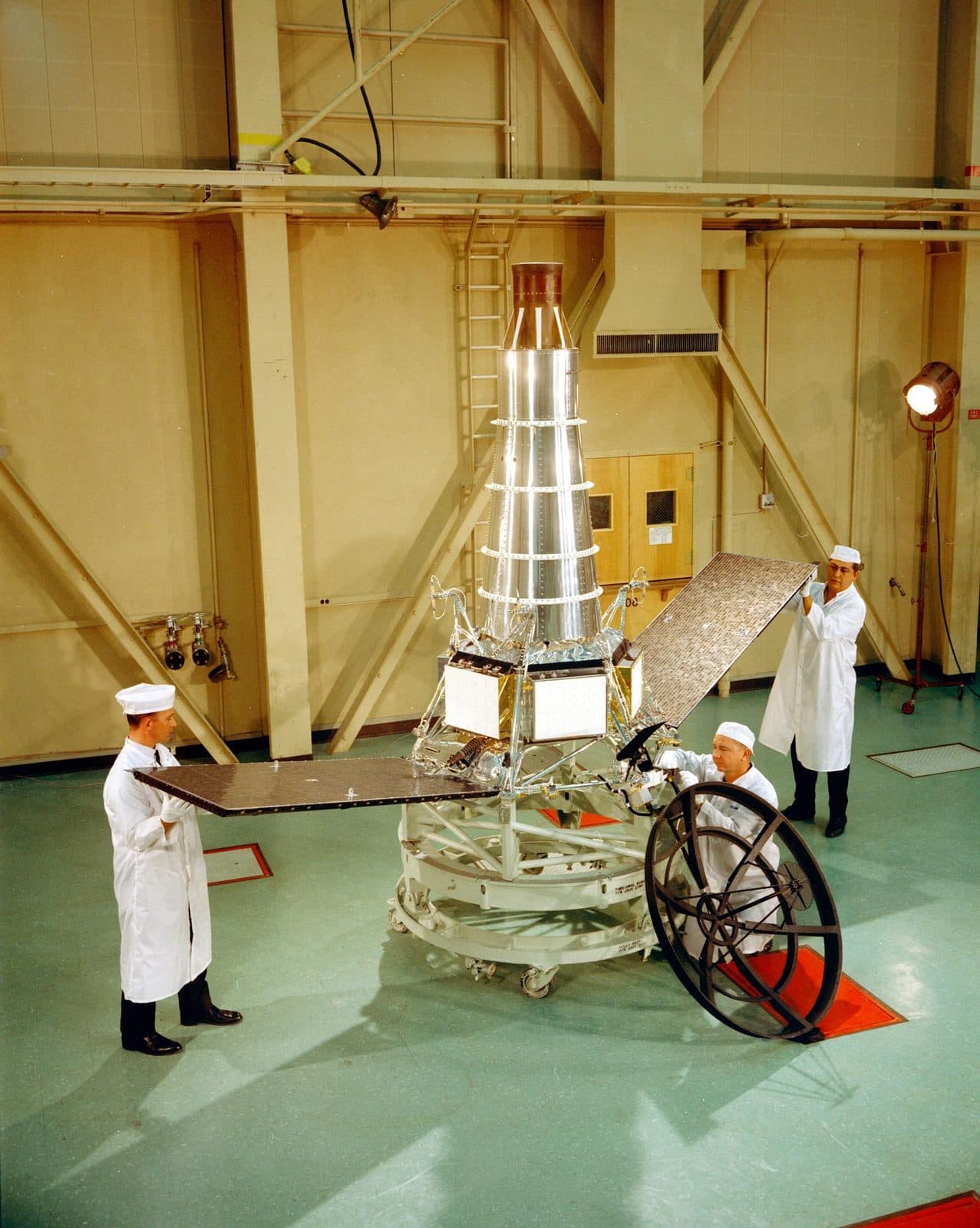
Ranger 7
NASA JPL · Block III Lunar Impactor
Built with no landing gear, no parachutes, and no return rockets. Ranger 7 had a single job: aim directly at the Moon and transmit close-up pictures until the millisecond it struck the surface.
Six Rangers Before It
The Pressure on NASA
America had suffered 13 consecutive failed Moon attempts. Rangers 1 and 2 stalled in Earth orbit. Rangers 3 and 5 missed the Moon completely. Ranger 4 hit the far side with a dead radio. In January 1964, Ranger 6 hit on target, but an electrical short during launch fried its cameras. Ranger 7 had to work.
Liftoff from Cape Canaveral
28 July 1964 · 16:50:07 UTC
An Atlas LV-3 Agena-B rocket roared from Launch Complex 12 in Florida, pushing the 362 kg spacecraft out of Earth orbit and onto a 68-hour collision trajectory toward the Moon.
The Lucky Peanuts
JPL Space Flight Operations Facility
With national pride and the Apollo schedule at stake, mission engineer Dick Wallace passed around jars of peanuts in the control room to calm frayed nerves. Ranger 7 went on to perform flawlessly, cementing a 60-year JPL tradition: lucky peanuts must be present at every major NASA planetary landing.
First Close-Up in History
31 July 1964 · 13:08:45 UTC
At an altitude of 2,110 km above the Moon, Camera F-a initiated its transmission to the Goldstone Deep Space Station in California. The 108-km crater Alphonsus came into sharp focus—the very first close-up photograph of the lunar surface taken by an American spacecraft.
Guericke Crater at 9,400 km/h
13:17:32 UTC · Altitude 1,083 km
Falling at 2.62 km/s (9,432 km/h), all six RCA Vidicon cameras fired in rapid sequence across two independent radio channels (959.52 MHz and 960.58 MHz). As altitude dropped past 1,000 km, the crater Guericke filled the screen, resolving details 1,000 times sharper than any telescope on Earth.
Proving Apollo Could Land
T-2.5 Seconds · Altitude 5.85 km
Prominent scientists feared the lunar plains were vast oceans of powdery dust that would swallow the Apollo Lunar Module whole. Ranger 7's final full frames resolved small craters down to 38 centimeters across, proving the dark plains were solid, compacted regolith ready for human exploration.
Static and Impact
31 July 1964 · 13:25:48.82 UTC
At 519 meters above the ground, Camera P-3 was mid-scan when the spacecraft slammed into the regolith at 2.62 km/s. The right side of the final frame dissolves into raw receiver static at the exact millisecond Ranger 7 shattered. The crash site was officially named Mare Cognitum: The Sea That Has Become Known.
Still Resting in Mare Cognitum
Apollo 16 & Lunar Reconnaissance Orbiter
Ranger 7 left a fresh 14-meter-wide impact crater in the lunar soil. Photographed from orbit by Apollo 16 astronauts in 1972, NASA's Lunar Reconnaissance Orbiter mapped the impact crater at 0.5-meter resolution in 2010—a silent monument to the 4,308 pictures that cleared the way to the Moon.
The end
Thank you, Ranger 7.
Sources
- NASA NSSDCA Master Spacecraft Page (1964-041A)
- NASA NSSDCA Television Experiment Record (1964-041A-01)
- Lunar and Planetary Institute (LPI) Ranger 7 Photo Archive
- LROC Orbital Analysis & Impact Crater Imagery (Frame M153014430L)
- NASA History: Lunar Impact (NASA SP-4210)
- NASA Science: Ranger 7
Every photo is from NASA's public archive and credited on screen; the cruise and silence scenes are drawn, and the bouncing path is an illustration, not to scale. NASA does not endorse this site.