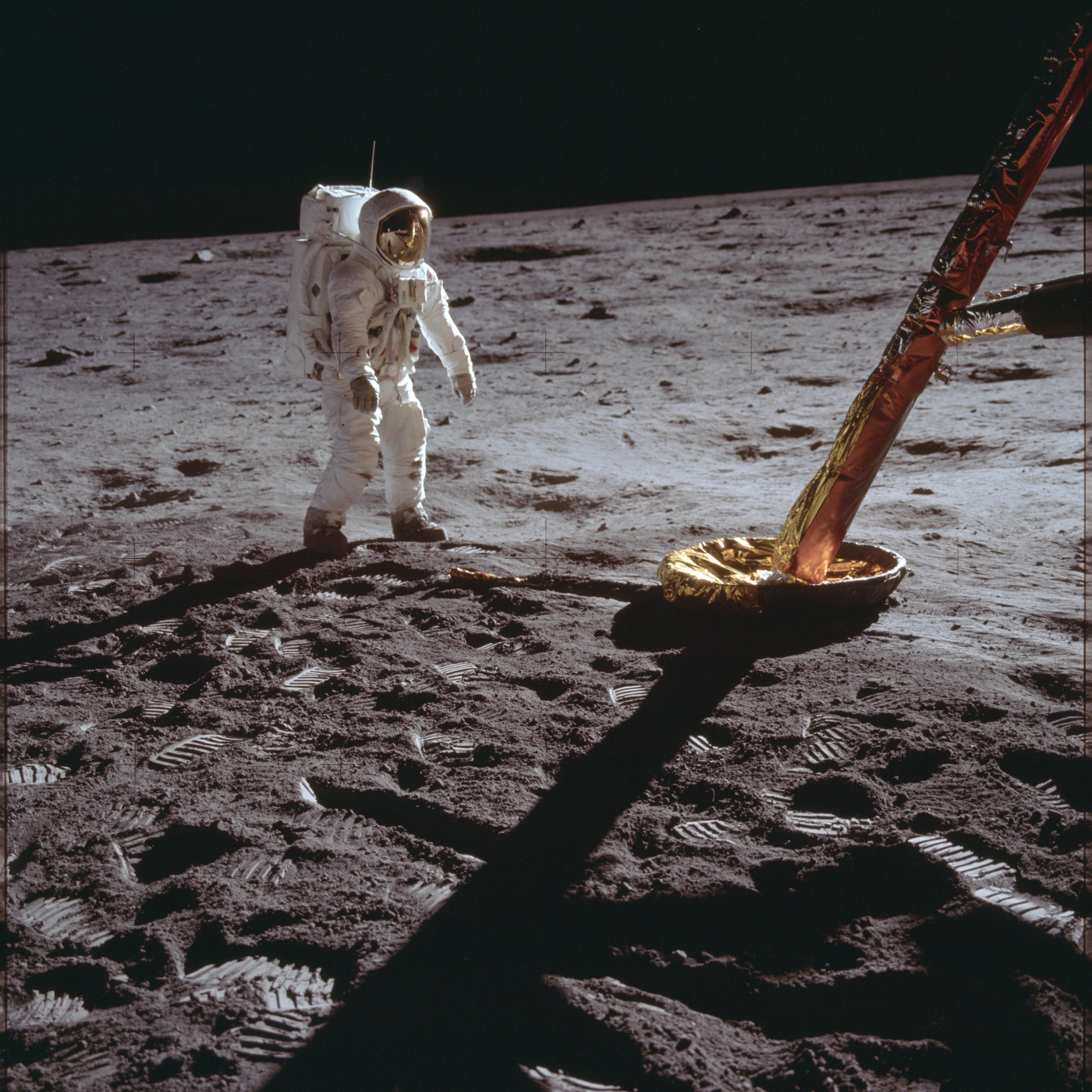
Apollo 11 / Eagle / LM-5
The part that
stayed.
Neil and Buzz had a way home. Part of me was built to stay behind.
Come into my memories. One thought at a time.
10 true-event chapters.
Imagined machine thoughts, grounded in mission records.
Chapter 1 / 10 · 20 July 1969
Two spacecraft, one promise
Above the Moon
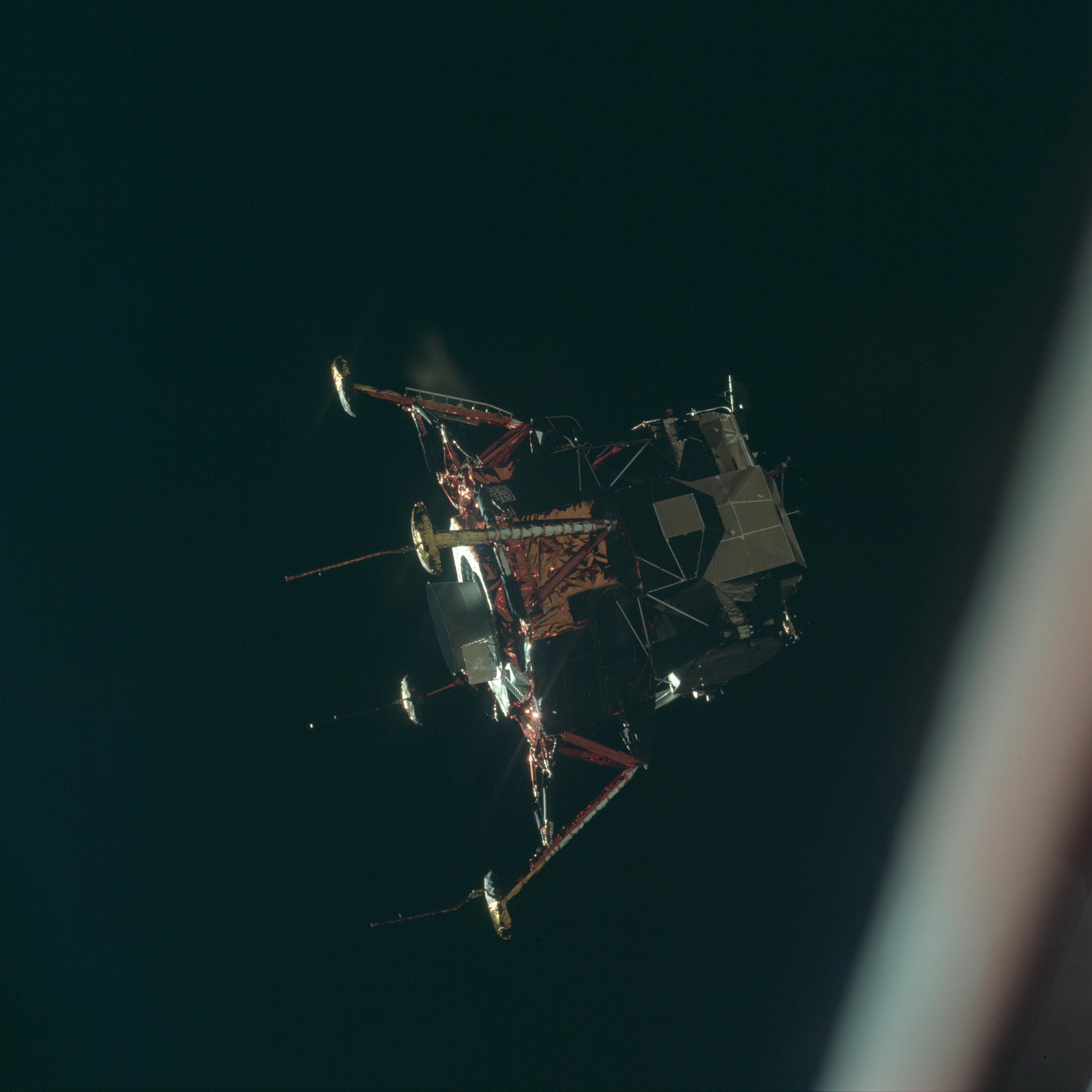
I am Eagle. Neil and Buzz were coming down to the Moon with me.
Michael Collins would stay above us in Columbia. Before the landing could begin, our two spacecraft had to separate.
Michael watched as I turned outside his window.
My landing gear was already extended. He checked it and filmed the little spacecraft that would carry his crewmates toward the surface.
I had two stages, and each carried a different job.
My lower stage held the landing engine and legs. My upper stage held the cabin and another engine for the return to orbit.
Columbia stayed in orbit. My landing journey could begin.
The two parts of me remained joined. Separating from Columbia was the start of a carefully planned trip down—and a meeting in orbit to come.
I was descending toward the Moon with Neil and Buzz when 1202 lit my display.
My guidance computer had more work than it could handle. The warning reached the crew while the landing was still unfolding.
Too much work did not mean that all my work had stopped.
Restart protection preserved essential guidance tasks. My software could recover important calculations while lower-priority work was set aside.
People in Houston listened, checked, and made a decision.
Steve Bales and the guidance team assessed the recovery. Charlie Duke passed the decision to continue to the astronauts.
I kept guiding. The crew kept flying.
The landing could continue because software protection and human judgment worked together. Understanding the warning mattered as much as noticing it.
I was Eagle, close to the lunar ground—and boulders lay ahead.
Neil Armstrong needed somewhere the lander could settle. Reaching the Moon was not enough; the final patch of ground mattered.
Neil guided me beyond the rough ground while Buzz called out our motion.
Armstrong used partial manual control. My descent engine could change its thrust as the crew managed the approach.
A long probe reached the surface before my footpad did.
The contact-light call told the crew a probe had touched. The engine-shutdown calls followed as the landing was completed.
My legs had a new job: hold our little outpost steady.
The landing stage supported the cabin and the equipment the astronauts would use outside. Tranquility Base was ready for their surface work.
Neil was climbing down my ladder. People on Earth were waiting to see.
I was Eagle, standing at Tranquility Base. A television camera travelled inside my equipment bay, but its view had to be opened.
A pull on a lanyard lowered the hinged bay.
The bay was called MESA. Lowering it exposed the camera's view toward my ladder and footpad.
My camera and radio equipment helped carry the view home.
As Neil moved toward the surface, people far away could follow the first steps through equipment beside the ladder.
An equipment box had become a window for Earth.
Later the astronauts moved the television camera to a tripod to show their work. The same camera could tell more of the visit from a new position.
I had carried a way to listen beneath the quiet lunar ground.
Eagle's crew brought a passive seismic package outside. This instrument measured ground motion rather than listening through air like a microphone.
The astronauts set it down, levelled it, and opened its solar panels.
Placement and power mattered. The instrument needed to be ready before tiny movements could become useful observations.
Even the crew's footsteps became something the instrument could detect.
Their movements nearby produced signals. Engineers and scientists could examine what the seismic package recorded.
The visitors would leave. A new way to study the Moon had begun.
The package remained on the surface. Its observations joined the mission's scientific record, connecting an instrument on the ground to questions on Earth.
Among the experiments I carried was a panel that needed no battery.
The Apollo 11 astronauts placed it on the Moon. Its hundred corner cubes were shaped to return incoming light toward its source.
An observatory on Earth supplied the light.
Scientists could send a laser pulse toward the lunar array and measure how long its return took. The reflector itself did not send a radio message.
One return was a measurement. Many returns could reveal a pattern.
Repeated observations from the lunar arrays let scientists investigate the Moon's motion over time, instead of guessing from one flash.
Something left in the dust became part of a very long experiment.
Lunar laser ranging has helped measure the Moon's recession and provided evidence about its interior, including a fluid core.
Before the moonwalk ended, one experiment needed a ride home.
Buzz returned to the solar-wind collector he had set up earlier. Its aluminium foil had been catching particles streaming from the Sun.
While the crew worked, the foil had been doing a job of its own.
Solar-wind particles became trapped in the exposed metal. The next part of this experiment would happen in a laboratory on Earth.
Buzz rolled the foil up and packed it for the return flight.
The collector went into a protective bag and then a sample container. Unlike the reflector, this experiment depended on bringing its evidence home.
The foil came home. Its supporting staff stayed behind.
Scientists studied solar-wind material, including helium, neon, and argon. Different pieces of one experiment had different endings.
Neil and Buzz were preparing my cabin to leave the Moon when a small control mattered greatly.
Buzz Aldrin had found the engine-arm circuit breaker's knob broken off. The crew still needed to prepare the ascent system.
The damaged knob made an ordinary action difficult.
The breaker was on Panel 16. A problem with its control did not mean that a pen could replace an engine or supply electricity.
Buzz used a felt-tip pen to push the breaker in.
The pen helped him operate the damaged control. Houston later confirmed that the engine-arm circuitry looked fine.
A small problem had been handled. The preparations could continue.
The crew still followed the ascent preparations. Their everyday tool had helped with one important step toward leaving the surface.
I was Eagle, and it was time to send Neil and Buzz back toward Columbia.
They were inside my upper stage. The landing engine and legs below them had already done their work on the surface.
My two stages were built to part when the return journey began.
The upper stage carried its own engine. It could leave without lifting the landing engine, landing legs, and other equipment back to orbit.
My ascent engine fired. The cabin rose from the platform beneath it.
The descent stage served as the launch platform. Neil and Buzz departed for their rendezvous with Michael Collins.
One part of me went with them. One part of me had finished its journey.
My landing stage remained at Tranquility Base. Staying was part of the design that helped the crew leave.
Long after my crew left, another spacecraft looked toward Tranquility Base.
Lunar Reconnaissance Orbiter carried a camera above the Moon. It could photograph the place where Eagle's landing stage remained.
From orbit, I was a small shape with a shadow.
The archived image showed the landing site from a different viewpoint. It was a later observation, not a live camera beside me.
A newer machine helped people study an older machine's visit.
The photograph could be considered alongside the crew's recordings and mission records. Different sources preserved different parts of the story.
I no longer needed to speak for people to find my story.
My descent stage had stayed where its work ended. The camera's record gave another generation a way to look back at that place.
Eagle / A story remembered
They never came back.
So we bring their stories home.
The landing stage, the instruments, the traces in the dust. You’ve met the machine behind them.